Data guide / Concentration guide
What percentage of snail mucin actually works?
The clinical trial evidence is for SCA (Cryptomphalus aspersa secretion) at 8% and 40% — real RCTs with measured facial outcomes. The '96%' and '92%' on Korean snail-essence labels describe a completely different thing: how much of the formula is filtrate, not a standardized dose of any active.
SCA clinical trial concentrations
8–40%
A 14-week, double-blind, randomized split-face trial tested an 8% SCA emulsion plus a 40% SCA serum and found significantly improved periocular wrinkles versus placebo. A separate split-face RCT used SCA 40% after non-ablative fractional laser and found significant improvements in elasticity, wrinkle area, and hydration. Both are genuine, percentage-specific human trials — for the specific SCA extract. The popular Korean 'snail 96%' and 'snail 92%' essences and creams use a related but distinct filtrate (Helix aspersa Muller), and their high percentages describe filtrate content in the formula, not a standardized dose of any measured active — the two numbers aren't answering the same question.
02 / What's actually in it
Why snail mucin's 'percentage' is genuinely two different questions
Snail secretion filtrate is not one molecule — it's a complex biological mixture containing glycosaminoglycans and other polysaccharides, glycoproteins (mucin, lectin), antibacterial peptides, antioxidant enzymes, and small amounts of allantoin and glycolic acid. A chemical characterization of Helix aspersa Muller mucus specifically found only small amounts of glycolic acid and allantoin, contradicting the popular marketing claim that snail mucin is 'packed with glycolic acid' — it doesn't function as an AHA exfoliant. In cell culture, snail secretion stimulates keratinocyte and fibroblast proliferation, migration, and survival, and promotes extracellular-matrix assembly — a plausible mechanism for the hydrating, plumping, repair-supporting reputation. The key complication for a percentage guide: 'concentration' can mean the proportion of the whole formula that's filtrate (the Korean-essence convention) or a standardized dose within a specific branded extract (the SCA clinical-trial convention), and these are not comparable numbers.
- Study Helix aspersa Muller mucus (HelixComplex) was non-cytotoxic, protected fibroblasts from apoptosis, and significantly induced cell proliferation and migration, while chemical characterization found it contained only small amounts of glycolic acid and allantoin. 3
- Study A secretion of the mollusk Cryptomphalus aspersa (SCA) promotes proliferation, migration and survival of human keratinocytes and dermal fibroblasts in vitro in a time- and dose-dependent manner. 4
03 / 8% and 40% SCA — the clinical trial doses
What 8% and 40% SCA actually did in controlled human trials
The strongest concentration-specific evidence for topical snail secretion comes from the branded SCA (Cryptomphalus aspersa secretion) extract, not from generic 'snail mucin.' A 2-center, double-blind, randomized, 14-week split-face study of 25 patients with moderate-to-severe facial photodamage used an 8% SCA emulsion combined with a 40% SCA serum, and found a significant improvement in periocular wrinkles versus placebo (P=.03), along with improved texture. In a separate randomized, double-blind, split-face trial of 20 patients, SCA 40% applied after non-ablative fractional laser significantly reduced microcolumn density and improved elasticity, wrinkle area, and hydration versus vehicle. These are the two real, dose-specific human RCTs behind snail mucin's clinical reputation — and both used the specific branded SCA extract, applied as part of a defined regimen (an 8% emulsion plus a separate 40% serum, or 40% alone post-procedure), not a single all-purpose percentage.
- Study In a 2-center, double-blind, randomized, 14-week split-face study of 25 patients with moderate-to-severe facial photodamage, an 8% SCA emulsion plus a 40% SCA serum significantly improved periocular rhytides versus placebo (P=.03) and improved texture. 1
- Study In a randomized, double-blind, split-face trial in 20 patients, SCA 40% applied after nonablative fractional laser significantly reduced microcolumn density and improved elasticity, wrinkle area, and hydration versus vehicle. 2
04 / Why '96% snail mucin' isn't the same claim
What the Korean-essence '92%' and '96%' labels actually mean
COSRX's Advanced Snail 96 Mucin Power Essence and Advanced Snail 92 All In One Cream, and Mizon's Snail Repair Intensive Essence, are among the category's best-known products, and their high percentages are genuinely accurate — they describe how much of the finished formula is snail secretion filtrate. But that is a different measurement from the 8%/40% SCA figures in the clinical trials above: those numbers describe how much of a specific, standardized branded extract was used within a defined treatment regimen, tested against placebo. A 96% filtrate essence has not itself been tested in a published RCT against a lower-percentage or placebo comparator, and the filtrate it contains (typically Helix aspersa Muller) is a related but distinct material from the clinically studied SCA (Cryptomphalus aspersa) extract. Neither number is wrong — they're just not answering the same question, and treating '96%' as directly comparable to '40% SCA, clinically proven' overstates what the label tells you.
One honest caveat No published RCT has tested a mass-market Helix aspersa Muller filtrate essence (of any stated percentage, including 92% or 96%) against a lower-percentage or placebo comparator. The 8%/40% clinical data is specific to the branded SCA (Cryptomphalus aspersa) extract.
05 / Summary
Key takeaways
- 8% SCA emulsion plus 40% SCA serum significantly improved periocular wrinkles versus placebo in a 14-week, 25-patient split-face RCT — genuine percentage-specific clinical evidence for the branded SCA extract.
- 40% SCA alone significantly improved elasticity, wrinkle area, and hydration after laser treatment in a separate 20-patient split-face RCT.
- The '96%' and '92%' figures on popular Korean snail essences and creams (COSRX, Mizon) describe filtrate content in the formula, not a standardized active dose — they are not the same kind of number as the SCA clinical percentages.
- Chemical analysis of Helix aspersa Muller mucus found only small amounts of glycolic acid and allantoin — the popular 'packed with glycolic acid, basically an AHA' claim is overstated regardless of the filtrate percentage.
- No published RCT has tested a mass-market snail-filtrate essence at its labeled percentage against a lower-percentage or placebo comparator — the clinical proof and the marketing percentage come from two different materials.
Decision / What to buy
What actually discloses Snail Mucin (Snail Secretion Filtrate)'s %
Every product below states its Snail Mucin (Snail Secretion Filtrate) percentage on the label or product page — ranked cheapest first by price per gram of active.
- 01Shop $19.00
SOME BY MI
Snail Truecica Miracle Repair Cream
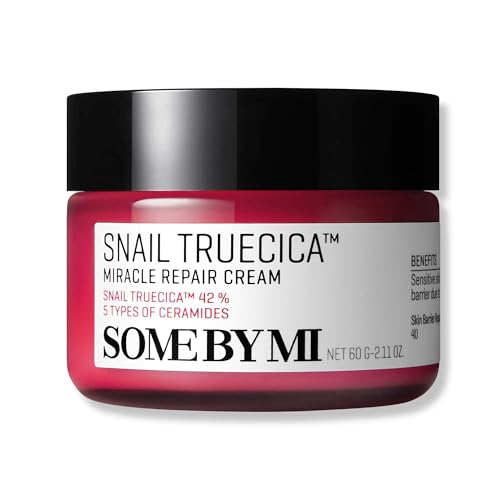
Affiliate links — we may earn a commission at no extra cost to you. Prices and disclosed % are set by the brand and can change.
06 / Questions
Frequently asked
- What percentage of snail mucin actually works?
- The clinical trial evidence is specific: an 8% SCA emulsion combined with a 40% SCA serum significantly improved periocular wrinkles in a 14-week RCT (PMID:23652894), and 40% SCA alone improved elasticity, wrinkle area, and hydration after laser treatment in a separate RCT (PMID:31222893). Both used the branded SCA (Cryptomphalus aspersa) extract specifically, not generic snail filtrate at those percentages. 12
- Is a 96% snail mucin essence better than a lower-percentage one?
- It contains more filtrate by formula weight, which is a real and verifiable claim, but it hasn't been tested in a published RCT against a lower-percentage product. The clinically proven percentages (8% and 40%) come from the specific branded SCA extract used in controlled trials, not from mass-market Helix aspersa Muller essences like COSRX's Advanced Snail 96 Mucin Power Essence. A higher filtrate percentage is a reasonable-sounding claim, but it isn't the same thing as clinical proof at that number. 1
- Is snail mucin really packed with glycolic acid?
- No — this is overstated marketing. A chemical characterization of Helix aspersa Muller mucus found only small amounts of glycolic acid and allantoin, and snail mucin has no low-pH requirement, so it doesn't function as an AHA exfoliant regardless of the percentage on the label (PMID:30518946). Its benefits come from glycoproteins, polysaccharides, and antioxidant enzymes — hydrate-and-repair, not resurface. 3
- What's the difference between SCA and the snail mucin in Korean essences?
- They're closely related but not identical. SCA (Cryptomphalus aspersa secretion) is a specific branded extract with the strongest published human RCT evidence, tested at 8% and 40%. Mass-market Korean essences (COSRX, Mizon, and others) typically use Helix aspersa Muller filtrate, a related species' secretion with supportive in-vitro and animal evidence but far less large-scale clinical-trial data of its own. Both share the same general mechanism, but a specific SCA trial result shouldn't be assumed to transfer directly to a Helix aspersa Muller essence. 13
- Does snail mucin actually reduce wrinkles?
- The SCA-specific evidence says yes, at the studied doses: the 14-week RCT found significantly improved periocular wrinkles at 8%/40% SCA versus placebo (PMID:23652894), and the post-laser RCT found improved wrinkle area at 40% SCA (PMID:31222893). Set expectations for gradual, modest improvement measured against placebo in controlled trials, not a dramatic transformation, and remember that mass-market snail essences at their own stated percentages haven't been tested the same way. 12
07 / References
Sources
- 1
- 2
- 3
- 4