Data guide / Concentration guide
What percentage of panthenol actually works?
5% dexpanthenol is the concentration behind the repeated barrier-repair and irritation-protection RCTs, and one dose-ranging study found hydration and barrier benefits kept improving up to roughly 7-11%, with no published data testing meaningfully higher.
Evidence-backed range
5–11%
5% dexpanthenol is the field-standard concentration: it's the dose used in a placebo-controlled RCT that protected skin from surfactant irritation, and in a wound-healing RCT that upregulated repair genes at the biopsy level. A separate formulation-optimization study tested a wider range (5-13%) and found hydration and transepidermal water loss (TEWL) improvements kept getting better up to about 7-11%, without a clear ceiling identified below 13%. There's no evidence that going meaningfully higher than that helps, and no published trial has tested panthenol below 5% against 5% head-to-head, so 5% remains the number with the most independent RCT support.
02 / How it works
Why panthenol's concentration question is different from an acid's
Panthenol is provitamin B5: skin converts it to pantothenic acid, a building block of coenzyme A, which cells need to synthesize the fatty acids and sphingolipids that hold the stratum corneum barrier together. That gives it a genuine metabolic mechanism rather than a receptor-saturation or pH-triggered one, which is part of why panthenol doesn't have a sharp 'ceiling' concentration the way L-ascorbic acid does. The clinical performance of topical dexpanthenol (the stable alcohol form used in most products) depends on good skin penetration and reaching adequate local concentration in a suitable vehicle — meaning the percentage and the formulation are somewhat inseparable variables in the published research.
- Study Dexpanthenol is converted in tissues to pantothenic acid, a component of coenzyme A, which catalyses early steps in synthesis of the fatty acids and sphingolipids crucial for stratum-corneum lipid bilayers and cell-membrane integrity. 1
- Review The clinical performance of topical dexpanthenol depends on good skin penetration and high local concentrations achieved in an adequate vehicle, such as water-in-oil emulsions. 2
03 / 5% — the reference concentration
5% dexpanthenol: the concentration behind the repeated RCTs
5% is the concentration used across the panthenol literature's best-controlled human trials. A double-blind, placebo-controlled RCT tested 5% dexpanthenol (as a commercial hand balm) against placebo under a standardized sodium lauryl sulfate irritation challenge in 25 subjects (21 completed): the dexpanthenol-treated sites showed significantly better hydration by corneometry, while the placebo sites showed a significant hydration decrease after the SLS challenge. Separately, a punch-biopsy RCT using 5% dexpanthenol ointment versus placebo found it modulated gene expression in skin wound healing in vivo, upregulating wound-repair-associated genes. Between a genuine placebo-controlled irritation-protection trial and a molecular wound-healing trial, 5% is the concentration with the most independent RCT backing in the published record.
- Study In a double-blind, placebo-controlled RCT (n=25, 21 completed) using a standardized sodium lauryl sulfate irritation challenge, 5% dexpanthenol was superior to placebo on corneometry-measured hydration at treated sites, while placebo sites showed a significant hydration decrease after the SLS challenge. 3
- Study A punch-biopsy RCT using 5% dexpanthenol ointment versus placebo found dexpanthenol modulates gene expression in skin wound healing in vivo, upregulating wound-healing-associated genes. 4
04 / 7–11% — where a dose-ranging study found the optimum
One study tested a wider range and found 7-11% outperformed 5%
A formulation study in 40 women tested semisolid panthenol formulations across a wider range — 5% to 13% by weight — measuring skin hydration, transepidermal water loss (TEWL), and surface pH with instrumental methods. The best in-vivo results (greatest hydration increase, greatest TEWL decrease) were found in the 7-11% range, with oil-in-water formulations outperforming water-in-oil at those concentrations. This is a real, percentage-specific finding, and it's the only published work that tests panthenol across a range rather than at one fixed dose. The honest caveat: it's an in-vivo instrumental measurement study, not a blinded, placebo-controlled RCT, so it establishes a plausible optimum rather than the kind of definitive dose-response curve a phase 3 drug trial would produce. No study has tested concentrations above 13%, so there's no data on whether going higher helps, does nothing, or increases irritation risk.
- Study A study testing semisolid panthenol formulations from 5-13% by weight in 40 women found the greatest in-vivo hydration increase and TEWL decrease in the 7-11% range, with oil-in-water formulations outperforming water-in-oil at those concentrations. 5
One honest caveat This is an in-vivo instrumental measurement study (corneometry, TEWL) in 40 women, not a blinded, placebo-controlled randomized trial. It's the only published work testing panthenol across a percentage range, and no study has tested concentrations above 13%.
05 / Below 5% — the honest gap
What about products using 1-2% panthenol?
Many moisturizers and 'B5' serums use panthenol well below 5%, often alongside other humectants, and there is no published RCT testing those lower concentrations against 5% or against vehicle. This doesn't mean 1-2% panthenol does nothing — the mechanism (supporting pantothenic acid/coenzyme A metabolism and acting as a humectant) doesn't have an obvious hard threshold — but it does mean the specific clinical trial evidence in this guide is anchored at 5% and above, not at the lower doses common in mass-market moisturizers. If a product doesn't disclose its panthenol percentage, there's no way to know whether it's closer to the well-evidenced 5% tier or to an untested trace amount.
One honest caveat No published RCT has tested panthenol below 5% against a higher concentration or against vehicle. Products in this range are common but sit outside the concentration range with direct clinical trial support.
06 / Summary
Key takeaways
- 5% dexpanthenol is the concentration behind the best-controlled human trials: a placebo-controlled RCT showing protection against surfactant-induced irritation, and a punch-biopsy RCT showing upregulation of wound-healing genes.
- One dose-ranging formulation study (5-13%, n=40) found hydration and TEWL improvements were greatest in the 7-11% range — a real finding, though from an instrumental measurement study rather than a blinded RCT.
- No published research has tested panthenol above 13%, so there's no evidence that higher concentrations help.
- No RCT has tested panthenol below 5% against 5% or against vehicle — products using 1-2% panthenol (common in mass-market moisturizers) sit outside the range with direct clinical support.
- The vehicle matters almost as much as the percentage: the dose-ranging study found oil-in-water formulations outperformed water-in-oil at the same panthenol concentration.
Decision / What to buy
What actually discloses Panthenol (Provitamin B5)'s %
Every product below states its Panthenol (Provitamin B5) percentage on the label or product page — ranked cheapest first by price per gram of active.
- 01Shop $8.54
AFCRYIYE
5% Panthenol (Vitamin B5) Face Serum
- 02Shop $17.50
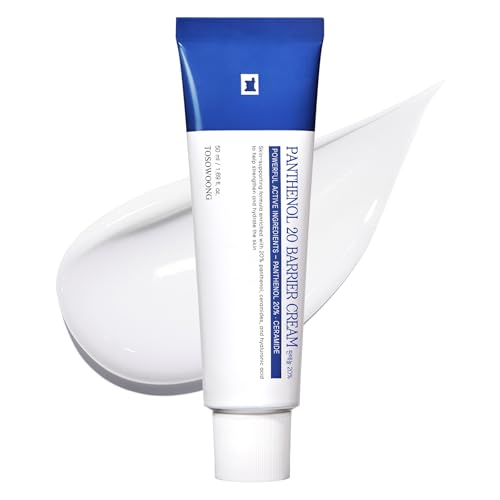
TOSOWOONG
Panthenol 20 Barrier Cream
- 03Shop $19.99
GPC Green Pharm Cosmetic
9% Panthenol Cream


Affiliate links — we may earn a commission at no extra cost to you. Prices and disclosed % are set by the brand and can change.
07 / Questions
Frequently asked
- What percentage of panthenol actually works?
- 5% has the most independent RCT support — it's the concentration used in a placebo-controlled trial that protected skin from surfactant irritation (PMID:14641355) and in a wound-healing gene-expression RCT (PMID:22759998). A separate dose-ranging study found hydration and barrier benefits were greatest at 7-11% (PMID:29577586), though that study used instrumental measurement rather than a blinded RCT design. Either figure is defensible; below 5%, there's no direct trial evidence either way. 345
- Is more panthenol always better?
- Not established. The only study that tested a range (5-13%) found the best results around 7-11%, not at the top of that range, and no published research has tested concentrations above 13%. There's no evidence that a 13%+ product outperforms a well-formulated 5% one, and the formulation (oil-in-water vs water-in-oil) affected results as much as the raw percentage did in that study. 5
- Does a low-percentage panthenol product (1-2%) still work?
- Possibly, but it's genuinely untested. No published RCT has compared panthenol below 5% against 5% or against a vehicle control, so there's no direct clinical evidence either confirming or ruling out benefit at those lower, more common doses. The mechanism (supporting the skin's own coenzyme-A-driven lipid synthesis) doesn't suggest an obvious hard cutoff, but the trial evidence in this guide starts at 5%.
- What's the difference between panthenol and dexpanthenol?
- Dexpanthenol is the stable alcohol form of panthenol (D-panthenol) most commonly used in the clinical studies and in topical products, chosen for its good skin penetration. 'Panthenol' on an ingredient list and 'dexpanthenol' in the medical literature generally refer to the same active form used in skincare — the studies cited in this guide test dexpanthenol specifically at the percentages given. 2
- Does panthenol percentage matter for wound healing and post-procedure skin?
- Yes, at least at the studied dose: a punch-biopsy RCT using 5% dexpanthenol ointment found it modulated gene expression in skin wound healing in vivo, upregulating repair-associated genes versus placebo. That's a real, mechanistically grounded result at a stated percentage — reasonable support for using a 5%-labeled or 5%-equivalent panthenol product after procedures, lasers, or peels, though no higher concentration has been tested for this specific endpoint. 4
08 / References
Sources
- 1
- 2
- 3
- 4
- 5