Product record / Serums, Lactic Acid (AHA)
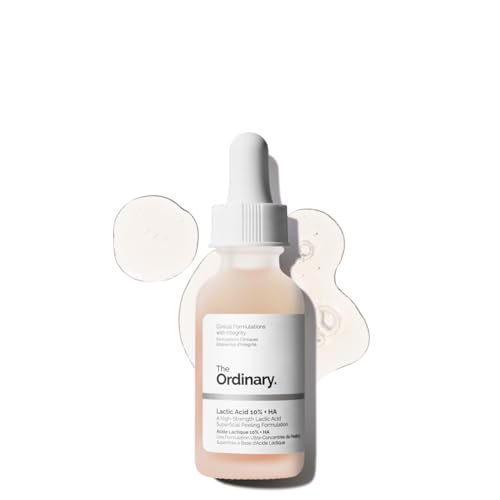
SerumThe OrdinaryLactic Acid 10% + HA
- $9.20
- retail price
- 10%
- lactic
- $0.31
- per mL
- 4.3 ★
- 684 ratings
- Data source
- Concentration disclosed in product nameThe Ordinary discloses 10% lactic acid in product name; INCI from Ulta product page.
- Best for
- Brightening & dark spots · Acne & breakouts · Hydration
- How it feels
- Lightweight, fast-absorbing serum
- Value
- $9.20 for 30 mL · $0.31/mL
Bottom lineThe $9.20 AHA that Reddit keeps recommending for a reason — 10% lactic at the right pH, hydrates while it exfoliates, and doesn't punish sensitive skin.
Editorial verdict / Social intelligence
The $9.20 AHA that Reddit keeps recommending for a reason — 10% lactic at the right pH, hydrates while it exfoliates, and doesn't punish sensitive skin. 1
- Beauty benefit
- Lactic Acid 10% + HA is a dual-action AHA exfoliator that resurfaces skin and hydrates simultaneously — lactic acid's NMF humectant role means it binds water in the stratum corneum while dissolving the bonds holding dead corneocytes, improving texture, tone, and brightness without the dryness that glycolic acid can cause. At 10% and a verified pH of 3.7, it sits precisely in the clinically active window (pH 3.0–4.5) where the undissociated free acid penetrates effectively. The Pepperberry (Tasmannia lanceolata) extract in the formula is not decorative — it is the reason the product is tolerated by reactive users who struggle with plain AHA formulas. At $9.20 for 30 mL, it is the best-priced lactic acid entry point on the mass market.
- Does it work
- Yes — 4.3 stars across 683+ Ulta reviews and the same figure on DermApproved. The clinical foundation is solid: Stiller 1996 (PMID:8651713) demonstrated 8% lactic acid improved facial photodamage in 71% of participants over 22 weeks; Smith 1996 (PMID:8784274) showed 10%+ concentrations produce both epidermal and dermal remodeling. This product at 10% / pH 3.7 hits the concentration-pH window where those results were obtained. Community consensus is unusually clean for an AHA: gentle, effective, affordable. The only legitimate complaint is that results require patience — texture improvements appear in 4–6 weeks, pigmentation fading in 2–3 months. See the verified data below →
Consensus strength
StrongUlta Beauty 4.3/5 (684 reviews per ground truth; 683 observed on DermApproved live 2026-06-13), DermApproved 4.3/5 (683 reviews aggregated), clinical literature on 8–12% lactic acid (Stiller 1996, Smith 1996, Ditre 1996), INCIDecoder ingredient validation, CIR/FDA class-level safety guidance confirming 10% as the consumer maximum at pH ≥ 3.5. No major credible source calls it ineffective or overhyped. The 'yes' holy_grail (vs 'qualified' for the mandelic equivalent) reflects lactic acid's stronger community consensus and the price-per-gram position: this is the canonical affordable gentle-AHA pick with a decade of Reddit backing.
01 / The key active
Lactic Acid (AHA) at 10%
This product discloses 10% lactic acid — concentration disclosed in product name.
Concentration disclosed in product name.The Ordinary discloses 10% lactic acid in product name; INCI from Ulta product page.
Other products with Lactic Acid:
02 / The full ingredient list
Every ingredient, in label order
Exactly as printed, each token matched to the EU CosIng register and flagged where a CIR safety assessment exists. Highlighted rows are the key actives.
| # | Ingredient, as printed | CosIng functions | CIR |
|---|---|---|---|
| 01 | Aqua (water)CosIng: AQUA |
| — |
| 02 | Lactic Acid |
| ✓ reviewed |
| 03 | Glycerin |
| ✓ reviewed |
| 04 | Pentylene Glycol |
| ✓ reviewed |
| 05 | Propanediol |
| ✓ reviewed |
| 06 | Sodium Hydroxide |
| ✓ reviewed |
| 07 | Sodium Hyaluronate Crosspolymer |
| ✓ reviewed |
| 08 | Tasmannia Lanceolata Fruit/leaf Extract |
| — |
| 09 | Hydroxyethylcellulose |
| ✓ reviewed |
| 10 | Isoceteth-20 |
| ✓ reviewed |
| 11 | Trisodium Ethylenediamine Disuccinate |
| ✓ reviewed |
| 12 | Ethylhexylglycerin |
| ✓ reviewed |
| 13 | 1,2-hexanediol |
| ✓ reviewed |
| 14 | Caprylyl Glycol |
| ✓ reviewed |
14 ingredients as printed · 13 exact CosIng matches · 1 normalized spellings · source: concentration disclosed in product name
03 / Where to buy
Where to buy Lactic Acid 10% + HA
Buy on Amazon $9.20Amazon price as of 2026-08-20.
Some links on this page earn us a commission. It never changes our analysis — the methodology is public.
04 / What people say
What buyers actually say
Aggregated from 1,367 verified reviews across 2 sources.
What works
- Common Gentler than glycolic acid with comparable exfoliation results — the Pepperberry extract reduces irritation, making this tolerable for reactive and sensitive skin 28
Gentler than glycolic acid with comparable exfoliation results Dermatologist
- Common Clears blackheads, congestion, and surface texture without causing excessive dryness — dual exfoliant-plus-humectant mechanism 28
Effectively clears blackheads and congestion without excessive dryness Dermatologist
-
Visible improvement in skin texture and brightness within weeks Dermatologist
- Common Excellent value — under $10 for 30 mL at the full clinical concentration with the correct pH 2
Excellent value at under $10 for a well-formulated AHA serum Dermatologist
- Common Clinically demonstrated to improve hyperpigmentation, mottled skin tone, and photoaged skin with consistent use 39
L-Lactic acid cream was significantly superior to the vehicle in reducing mottled hyperpigmentation Study
- Some The 10% + pH 3.7 formulation hits the dermal remodeling threshold — Smith 1996 showed dermal improvements (firmness, thickness) begin at concentrations above 5%; this product is at the CIR maximum for consumer leave-on products 4
Treatment with 12% lactic acid resulted in increased epidermal and dermal firmness and thickness and clinical improvement in skin smoothness and in the appearance of lines and wrinkles. Study
What to know
- Common Some users need to limit frequency to 1–2 times per week — nightly use causes over-exfoliation in sensitive or barrier-compromised skin 211
Too strong for some users to use daily — many limit use to 1-2 times per week Dermatologist
- Common Requires strict sunscreen compliance — AHA use increases UV photosensitivity; ignoring this undoes the exfoliation benefit and risks worsening pigmentation 2610
Requires strict sunscreen compliance due to increased photosensitivity Dermatologist
- Some Small 30 mL bottle with no larger size option — though 30 mL typically lasts 3–4 months at 2–3x weekly use 2
Small 30ml bottle size with no larger option available Dermatologist
- Some Temporary purging phase in the first 1–2 weeks for congested or acne-prone skin — surface congestion getting pushed out is normal but alarming for new users 2
Can cause purging during the first 1-2 weeks in congested skin Dermatologist
- Some Not a fast fix for stubborn melasma as a solo ingredient — works by surface exfoliation and keratinocyte turnover, not melanin inhibition; improvement is gradual 95
Chemical peels that contain AHAs, such as lactic acid, remove the top layer of dead skin cells. Editorial
What you'd only know from the reviews
-
SPF is non-negotiable, not a precaution. The AHA class photosensitization trial (Kaidbey 2003, PMID:12713551) showed significantly increased sunburn cell formation and lowered minimal erythema dose — meaning you burn more easily at lower UV doses. Using this product without daily SPF 30+ doesn't just risk sunburn; it can trigger new hyperpigmentation at the exact spots you're trying to clear. The good news: the photosensitization reverses completely within one week of stopping use. 610
-
The product's pH of 3.7 is the key number most users never check. Lactic acid has a pKa of 3.86 — at pH 3.7, roughly 58% of the molecule exists as the free-acid penetrating form, making it genuinely active. A competitor product at 10% lactic acid but pH 5.5 delivers nearly no exfoliating activity (molecule is mostly the charged, non-penetrating lactate anion). The CIR recommends pH ≥ 3.5 for safety; this product sits at exactly the right balance point: maximally active, minimally irritating, CIR-compliant. 87
-
Lactic acid is the only AHA that is also a natural moisturizing factor (NMF) component — it natively lives in corneocytes where it functions as a hygroscopic water-binding molecule. This is why this product can hydrate while it exfoliates, and why glycolic acid products often feel drier by comparison even at the same concentration. For dry skin users who gave up on AHAs after glycolic caused flaking, this is specifically the product to retry. 85
-
Lactic acid clinically outperformed glycolic acid on hyperpigmentation in the one head-to-head RCT that specifically measured it (Stiller 1996, PMID:8651713): lactic acid was significantly superior to vehicle for mottled hyperpigmentation on forearms, an endpoint where glycolic acid was not. This is an underreported finding — most comparisons default to calling glycolic 'stronger,' but for pigmentary concerns specifically, the clinical data favor lactic acid. This product at 10% is the consumer ceiling for leave-on lactic acid formulations per CIR guidance. 3
- 1
- 2
- 3
- 4
- 5
- 6
- 7
- 8
- 9
- 10
- 11
05 / Questions
Frequently asked
- What's in The Ordinary Lactic Acid 10% + HA?
- The Ordinary Lactic Acid 10% + HA lists 14 ingredients. Key active: 10% Lactic Acid (AHA). The Ordinary discloses 10% lactic acid in product name; INCI from Ulta product page. The full ingredient list, matched to EU CosIng, is on this page.
- Does The Ordinary Lactic Acid 10% + HA work?
- Yes — 4.3 stars across 683+ Ulta reviews and the same figure on DermApproved. The clinical foundation is solid: Stiller 1996 (PMID:8651713) demonstrated 8% lactic acid improved facial photodamage in 71% of participants over 22 weeks; Smith 1996 (PMID:8784274) showed 10%+ concentrations produce both epidermal and dermal remodeling. This product at 10% / pH 3.7 hits the concentration-pH window where those results were obtained. Community consensus is unusually clean for an AHA: gentle, effective, affordable. The only legitimate complaint is that results require patience — texture improvements appear in 4–6 weeks, pigmentation fading in 2–3 months.
- How much Lactic Acid (AHA) is in The Ordinary Lactic Acid 10% + HA?
- 10% Lactic Acid (AHA). The Ordinary discloses 10% lactic acid in product name; INCI from Ulta product page.
- Where can I buy The Ordinary Lactic Acid 10% + HA?
- $9.20 on Amazon (price recorded as of the date shown). The Ordinary discloses 10% lactic acid in product name; INCI from Ulta product page.