Ingredient guide / OTC acne drug
Benzoyl Peroxide
BENZOYL PEROXIDE
Which strength, which form, what to pair it with, and what to expect by week. It draws on the published trials, a panel of 22 sources, a count of 649 user comments, and the ingredient labels of 20 products.
- antimicrobial agent
- keratolytic
- oxidizing agent
- acne treatment active
Benzoyl peroxide is the over-the-counter acne drug every guideline puts first. It dries skin, bleaches fabric, and breaks down into benzene if stored hot; kept at room temperature, the FDA puts the risk as very low. On the face, 2.5% in a leave-on works about as well as 10% with far less peeling. In a wash that is rinsed off, 4–10% is the range the sources support.
01 / What this page adds
Seven numbers from the primary sources
One is a subtraction from a published trial; two are figures reported in the primary literature; four are computed from the tables lower on this page.
- +2.3 / +2.4
Going from 2.5% to 5% added 2.3 points of lesion clearance and 2.4 points of adverse-event incidence. 14
Kawashima 2017, n=609, 12 weeks: inflammatory-lesion reduction 72.7% vs 75.0%; patients reporting any adverse event 56.4% vs 58.8%. Two different measures, so this is a comparison, not a ratio.
- 2.13×
In the pooled trials, patients on benzoyl peroxide were about twice as likely to withdraw because of side effects as patients on placebo. 2
Reported in the Cochrane 2020 review (24 trials, 13,744 participants): RR 2.13, 95% CI 1.55–2.93. The efficacy figure usually quoted comes from the same review.
- 0 of 16
None of the 16 panel sources that state a strength puts a facial leave-on at 10%. The 10% recommendations are for washes or the body.
Tabulated from the consensus panel below. Two sources list 10% without saying which form; the rest either start at 2.5% or reserve 4–10% for washes.
- 0.00 vs 1.93 log
In the only direct comparison, an 8% wash produced no measurable drop in follicular bacteria at one week; a 5.3% leave-on foam cut them by 1.93 log. 17
Reported in Leyden et al. Small and non-randomized, with bacterial counts rather than lesion counts. It is the only head-to-head test of wash against leave-on.
- 37×
A gram of the active costs $0.65 in the cheapest wash and $23.92 in the priciest leave-on we priced.
Listed Amazon price ÷ (listed size × label %). Cheapest: PanOxyl 10% Foaming Wash, $10.19 for 5.5 oz. Priciest: La Roche-Posay Effaclar BPO, 5.5% on its Drug Facts label, $24.99 for 0.67 oz. Fluid ounces are converted at 28.35 g, which treats the product as water; the error is a few percent.
- 2 of 649
Two of the 649 community comments that mention benzoyl peroxide mention benzene or the recall. 209 mention dryness, peeling or burning.
Counted over comments and posts that themselves mention benzoyl peroxide, from 200 threads on three subreddits. The method and its limits are in the field-reports section.
- 7 of 12
Seven of the 12 benzoyl peroxide washes and bars we decoded carry a sulfonate or sulfate surfactant; none of the eight leave-ons does. Two of the 20 products contain fragrance.
From the full ingredient lists of 20 products, read from DailyMed labels and brand pages. Table and classification rule below.
Strength recommended by the 16 sources that state one
What a gram of the active costs, by product
02 / Effective concentration
What percentage works
Effective range
2.5-10%
The FDA monograph allows 2.5–10%. In the trials, 2.5% cleared inflammatory lesions about as well as 5% and 10% with less peeling. Start at 2.5% in a leave-on; use higher strengths in washes, on the body, or if 2.5% has plateaued.
- Study Across three double-blind studies (153 patients), 2.5% benzoyl peroxide gel was more effective than vehicle and equivalent to 5% and 10% concentrations in reducing inflammatory lesion counts. Desquamation and erythema were significantly less frequent with 2.5% than with 10%. 6
- Study Benzoyl peroxide at concentrations from 2.5% to 20% was assessed across 120 trials (29,592 participants); 2.5% and 5% were the most commonly studied concentrations (27 and 66 trials respectively). BPO was effective for reducing both inflammatory and total lesion counts versus placebo. 2
- Source FDA classified benzoyl peroxide as generally recognized as safe and effective (GRASE) for OTC topical acne treatment at concentrations of 2.5–10% (21 CFR Part 333, Subpart D, §333.310). Final rule published March 4, 2010 (75 FR 9767). 21 CFR 333.310 / 75 FR 9767 (March 4, 2010) ↗
- Study The minimum contact time for a bactericidal effect on C. acnes is nearly immediate with 5% or greater BPO, whereas ≤2.5% BPO requires longer contact time. All concentrations (1.25–10%) achieved bactericidal effects against both antibiotic-resistant and antibiotic-susceptible C. acnes strains. 5
Inflammatory lesions reduced at 12 weeks (median %)
Patients reporting any adverse event
03 / Which form
Which form: wash, leave-on, or spot
Benzoyl peroxide works only while it is on the skin, so a 10% wash rinsed off after ninety seconds and a 2.5% lotion worn all day are doing different jobs. The trials behind the "2.5% is enough" rule used leave-on gels. The form decides more than the percentage does.
| Form | Time on skin | % that makes sense | Best for | Watch out for |
|---|---|---|---|---|
| Wash / cleanser | 1–2 minutes, then rinsed | 4–10% | Face and body together; oily skin; people who cannot tolerate a leave-on; maintenance once clear | In the one direct comparison, a rinsed-off wash reduced bacteria far less than a leave-on. Rinse thoroughly; it still bleaches towels. |
| Leave-on lotion or gel | All day or all night | 2.5–5% | Inflammatory acne on the face — this is the form the equivalence trials used | Dryness and peeling in the first weeks; bleaches pillowcases; breaks down tretinoin applied at the same time. |
| Spot treatment | Overnight on one lesion | 5–10% | A single papule or pustule you want smaller by morning | Does nothing to prevent the next spot. Over-drying a spot on darker skin can leave a dark mark that outlasts the pimple. |
| Body wash | 1–3 minutes in the shower | 10% | Back, chest and shoulder acne — the body tolerates 10% far better than the face | Bleaching is worst here. White towels, and let it dry before putting on a colored shirt. |
- Study In vitro, 5% and 10% benzoyl peroxide killed C. acnes almost immediately on contact, while 1.25% and 2.5% needed longer contact time to reach the same bactericidal effect — the mechanism behind "short contact needs a higher %". 5
- Study In a small, non-randomized comparison, a 5.3% leave-on foam cut follicular P. acnes by 1.93 log after one week; an 8% wash produced no measurable reduction. These are bacterial counts; lesion counts were not measured. 17
- Study The 2.5% ≈ 5% ≈ 10% efficacy finding comes from leave-on gels. It does not extend to a 2.5% wash. 6
Body acne is the case for 10%
Skin on the back and chest is thicker and oilier than facial skin, and a body wash is on for a minute or two in the shower. That is the condition where the contact-time data favor the top of the range. Three of the 22 panel sources address body acne (Healthline, Good Housekeeping, NBC Select); all three recommend a 10% wash, and PanOxyl's 10% wash is the product the community names most for it.
04 / Who it is for
Which acne benzoyl peroxide treats — and which it doesn't
Benzoyl peroxide kills bacteria and loosens the keratin plug only mildly. Where it works and where it does not follows from that.
- Works Inflammatory acne (red papules, pustules) — The core use. Pooled across two 12-week trials (very low certainty evidence), patients on benzoyl peroxide ended with about 6 fewer inflammatory lesions than patients on placebo. In the largest single trial, 2.5% cleared a median 72.7% of them. 15
- Helps, not alone Comedonal acne (blackheads, whiteheads) — It helps: about 10 fewer non-inflammatory lesions than placebo in the same pooled data (very low certainty), a larger count because people start with more comedones than pustules. A retinoid such as adapalene is the drug built for comedones; the guidelines pair the two. 15
- Needs a prescription Nodular or cystic acne — Deep lesions need prescription treatment. Benzoyl peroxide stays in the routine alongside the antibiotic to keep bacteria from becoming resistant to it. 18
- Works Back, chest and shoulder acne — A 10% wash once a day in the shower, one to three minutes before rinsing. The body tolerates the full strength, and the three panel sources that address body acne all recommend this form. 23
- Helps, not alone "Fungal acne" (Malassezia folliculitis) — Benzoyl peroxide is active against Malassezia species in vitro, which is why it sometimes helps the itchy, uniform bumps that antibiotics never touch. An antifungal is the direct treatment. 1
- Wrong tool Rosacea — Rosacea is not driven by C. acnes, and benzoyl peroxide's irritation usually makes the redness worse. Azelaic acid is the over-the-counter option with evidence for it.
By skin type
- Oily
- The easiest case: the protocol below as written (a 4% wash in the evening, a 2.5% leave-on in the morning), with a 10% wash for the back and chest.
- Dry or dehydrated
- Start with a 4% creamy wash or a 2.5% leave-on on alternate days and moisturize right after. In a split-face trial, a ceramide and niacinamide moisturizer improved the tolerability of topical acne treatment. 20
- Sensitive
- Patch-test first. Up to 6.5% of US dermatology patients and 7.8% in a German-Austrian-Swiss series react to benzoyl peroxide on patch testing; those are clinic populations, and sensitization in acne patients using it normally is rare (0–1%). Begin at 2.5%, every other day. 8
- Darker skin tones
- Irritation is the risk, because irritated skin can leave post-inflammatory hyperpigmentation that lasts longer than the acne did. Use the lowest effective strength, and a rinsed-off wash before any leave-on.
- Pregnant or nursing
- Listed by ACOG as an OTC ingredient acceptable in pregnancy if needed. What is absorbed is converted to benzoic acid in the skin; around 5% reaches the bloodstream and leaves in urine. 1024
- Under 12
- The FDA monograph labeling says to ask a doctor before use in children under 12. 25
05 / How it works
What it does to the skin
On the skin, benzoyl peroxide breaks down and releases reactive oxygen that kills Cutibacterium acnes, the bacterium behind inflammatory acne. It also loosens the keratin plug at the pore, mildly. It is not an exfoliant in the way salicylic acid is, and it is not a retinoid.
- Study Benzoyl peroxide kills C. acnes by damaging the cell wall directly; in vitro, viable bacteria fall significantly within an hour at 0.5–2 mmol/L. 1
- Study C. acnes has never been shown to become resistant to benzoyl peroxide. Strains exposed repeatedly to clindamycin alone grew resistant; the same strains exposed to clindamycin plus benzoyl peroxide did not. 4
- Review It is bactericidal first; the comedolytic and anti-inflammatory effects are secondary. That is why it is strongest on papules and pustules and weakest on blackheads. 2
06 / The routine
A protocol, week by week
It assumes a 4% wash and a 2.5% leave-on, which is what the trials and the panel support for the face. Adjust down for sensitive skin and up for the body.
- Week 0 4% wash, evenings. Wet the face, work the wash over the whole area, leave it on for one to two minutes, rinse until the water runs clear, pat dry with a white towel, moisturize within a minute.
- Week 1 Add a 2.5% leave-on, mornings, every other day. A pea-sized amount over the areas that break out, then moisturizer, then sunscreen. If you see white residue, that was too much.
- Week 3 Leave-on every morning, if there is no stinging. Peeling in weeks one to three is the adjustment period. Stinging or new red bumps mean too much, too fast: go back to alternate days.
- Week 4 Add adapalene 0.1%, evenings, after the wash. Adapalene is stable next to benzoyl peroxide and treats the comedones benzoyl peroxide only half-treats. If you use tretinoin instead, keep it to the evening and the benzoyl peroxide to the morning.
- Week 8 Judge it. Inflamed spots should be noticeably fewer. If nothing has changed, the form is more likely wrong than the percentage: a 10% wash used twice a day on a dry face is a common failure; so is a 2.5% wash that is rinsed off immediately.
- Week 12 Maintain. This is the trial endpoint. Keep the wash, drop the leave-on to a few mornings a week, and keep the adapalene. On the face, 10% adds peeling; the equivalence trials found no extra clearance.
07 / Combinations
What to pair benzoyl peroxide with, and what to keep apart
Benzoyl peroxide is an oxidizer, and most of the pairing rules follow from that: it breaks down ingredients that oxidize easily (tretinoin, L-ascorbic acid) and leaves alone the ones that do not (adapalene, niacinamide, salicylic acid).
| With | Verdict | How | Why |
|---|---|---|---|
| Adapalene (Differin) | Pairs well | Same routine, even the same layer — or benzoyl peroxide in the morning, adapalene at night if you want the gentlest start. | Adapalene is chemically stable next to benzoyl peroxide in light and in dark; compounded adapalene (0.1% or 0.3%) with benzoyl peroxide (1% or 5%) creams kept their potency for 180 days. Epiduo is this pairing in one tube. 19 |
| Tretinoin | Same routine, different time | Tretinoin at night, benzoyl peroxide in the morning (or as a wash). Never in the same layer. | Mixed with 10% benzoyl peroxide and exposed to light, more than half the tretinoin was destroyed in about two hours and 95% within 24 hours. 9 |
| Retinol / retinal (cosmetic retinoids) | Same routine, different time | AM benzoyl peroxide, PM retinoid. | There is no direct study. Retinol and retinaldehyde share tretinoin's oxidation sensitivity, and keeping them in separate time slots costs nothing. |
| Salicylic acid | Pairs well | Salicylic wash, benzoyl peroxide leave-on — or the reverse. Watch cumulative dryness. | A 2.5% benzoyl peroxide + 0.5% salicylic acid system cut total lesions by a mean 61.6% at 12 weeks in its registration trial. 16 |
| Niacinamide | Pairs well | Any order, any time. | No interaction. In a split-face trial, a ceramide and niacinamide moisturizer improved the tolerability of topical acne treatment; it is the moisturizer to use over benzoyl peroxide. 20 |
| Topical clindamycin or erythromycin (Rx) | Pairs well | Together, ideally as a fixed-combination gel. | Benzoyl peroxide is what keeps the antibiotic working: strains exposed to clindamycin alone grew resistant, strains exposed to clindamycin plus benzoyl peroxide did not. The 2024 AAD guideline recommends the fixed combinations. 4 |
| Dapsone gel (Aczone, Rx) | Careful | Different times of day, and wash between them. | Applied one after the other, 7 of 95 trial patients developed a temporary yellow-orange discoloration of skin and facial hair that took 4–57 days to fade — it is in the dapsone prescribing information. 21 |
| Hydroquinone | Careful | Separate applications; do not layer. | Dermatologists report temporary dark staining when the two are layered. Keep the brightener for the evening and benzoyl peroxide for the morning wash. 23 |
| L-ascorbic acid (vitamin C) | Same routine, different time | Vitamin C in the morning under sunscreen; benzoyl peroxide as the evening wash or leave-on. | The same oxidation logic as tretinoin; ascorbic acid is the ingredient that turns brown in its own bottle. No trial has measured the loss, so the separation is precautionary. |
| AHAs (glycolic, lactic) | Careful | Alternate nights, not the same night. | Both dry and both exfoliate, so the irritation adds up. Nothing happens chemically between them; this is a tolerance rule. |
| Sulfur products | Careful | Pick one. | Listed as an interaction in clinical drug references for additive drying and irritation. 22 |
| Oral isotretinoin | Keep apart | Stop topical benzoyl peroxide unless your dermatologist says otherwise. | Isotretinoin thins and dries the skin; topical irritants on top of it are listed as an interaction to tell your care team about. 22 |
"Different time" means morning and evening, not different weeks. The blanket rule that actives must never be combined comes almost entirely from the two oxidation rows in this table.
08 / What to expect
What to expect, week by week
Bacterial counts fall within a day. Visible change takes two to four weeks. The trials measured at twelve. Most people who quit do so around week two, when peeling peaks and nothing has cleared yet.
- Day 1 Bacteria fall within hours; the skin looks the same. 5% and 10% are bactericidal against C. acnes almost on contact in vitro; lower strengths need longer contact. 5
- Weeks 1–3 Dryness and peeling peak. Dryness, irritation and redness are the most common adverse events across the trials, and they are dose-dependent: more frequent at 10% than at 2.5% or 5%. Starting every other day, with a moisturizer ready, gets most people through this window. 2
- Weeks 2–4 First visible reduction in new red spots. The dermatologists in our panel put the first noticeable change at two to four weeks; existing lesions still have to run their course. 23
- Week 8 Roughly half of total lesions gone, in the one trial whose week-8 figure we have. Total lesion count was down a mean 56.9% at week 8 in the registration trials of a 2.5% benzoyl peroxide plus 0.5% salicylic acid system. That is a combination, so treat it as an upper bound for benzoyl peroxide alone. 16
- Week 12 The trial endpoint: about three-quarters of inflammatory lesions cleared. Median reduction of 72.7% (2.5%) and 75.0% (5%) against 41.7% on placebo. 14
- After week 12 Maintain. If 2.5–5% has plateaued, 10% adds peeling more reliably than it adds clearance; the equivalence data run that way. Try a different form, or add adapalene, before changing the number. 6
09 / The picks
Six products, one per job
We did not test these on skin; see the method note.
Each product is here because the trials, the panel and the community point at it; the ones we cut were the same thing at a worse price per gram, or carried a caveat we could not resolve. Prices are Amazon's on the day this page was built. Percentages are from each product's Drug Facts label.
-

Best all-round wash — face and body
PanOxyl 10% Benzoyl Peroxide Acne Foaming Wash
10% · foaming wash · 5.5 oz · $10.19 · $0.65/g active
The product the community names most (32% of the 649 comments, though PanOxyl was one of our search terms), Dr Sadeghpour's pick for body acne on the NBC panel, and the cheapest gram of active on this page. Maximum strength in a wash that is rinsed off.
Too strong for a dry or sensitive face twice a day. Start with the 4% creamy wash below.
-
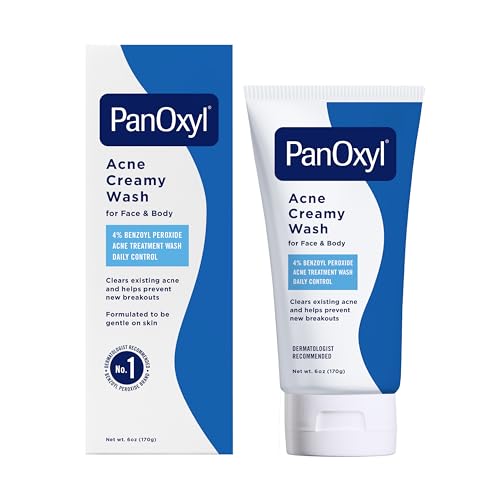
Gentler daily wash
PanOxyl Antimicrobial Acne Creamy Wash, 4%
4% · creamy wash · 6 oz · $10.19 · $1.50/g active
Same brand and price, a cream base instead of a foam, and less than half the strength. The daily face wash when the 10% is for the back.
-

Barrier-minded wash
CeraVe Acne Foaming Cream Cleanser, 4%
4% · foaming cream cleanser · 5 oz · $14.97 · $2.64/g active
The one mainstream benzoyl peroxide cleanser that carries ceramides, niacinamide and hyaluronate in the same bottle, NBC's best facial cleanser, and the choice for dry or combination skin that wants the active daily.
-

Daytime leave-on, 2.5%
Neutrogena Stubborn Acne AM Treatment, 2.5%
2.5% · leave-on lotion · 2 oz · $12.97 · $9.14/g active
The trial-strength leave-on: 2.5% micronized, in a vanishing base that goes under sunscreen. This is the form and dose behind the 72.7% clearance in the largest trial.
-

Overnight spot treatment, 10%
Neutrogena Rapid Clear Stubborn Acne Spot Treatment Gel, 10%
10% · spot gel · 1 oz · $9.68 · $3.41/g active
Maximum strength on one lesion overnight is the one place 10% belongs on the face. Apply a dot.
Not a preventative, and not for skin that marks easily; use a 2.5% spot cream instead.
-

The partner: adapalene 0.1%
Differin Acne Retinoid Treatment Gel, 0.1% Adapalene
0.1% · retinoid gel (not benzoyl peroxide) · 45 g · $23.97
Not benzoyl peroxide. Adapalene is the retinoid that is chemically stable next to it and the drug built for comedones. Wash with benzoyl peroxide in the evening, rinse, then adapalene: the two-product routine the 2024 guideline describes.
Amazon prices on the day this page was built; they change. $ per gram of active = listed price ÷ (listed size × label %), with fluid ounces converted at 28.35 g. Affiliate links; we earn a commission at no cost to you.
10 / Benzene
The benzene question, with the numbers
Benzoyl peroxide can break down into benzene, a carcinogen, when it gets hot. Valisure, an independent lab, said this made the products dangerous; the FDA tested them and found most were fine. They tested different conditions.
- FDA testing, 2025
- 95products tested; more than 90% had undetectable or extremely low benzene 13
- Recalled
- 7product listings across 5 brands: La Roche-Posay Effaclar Duo, two Proactiv products, two Walgreens products, SLMD and Zapzyt 13
- Valisure, baseline
- 94 / 99benzoyl peroxide products with detectable benzene straight off the shelf, before any heating 12
- Valisure, 50 °C for 18 days
- 2products above 1,500 ppm; 17 above 100 ppm; 42 above 10 ppm — against a 2 ppm FDA limit 12
- Review Benzoyl peroxide is thermally unstable by design — the same property that makes it work is the one that lets it degrade to benzene, and the rate is temperature-dependent. 7
- Source The FDA's position is that the cancer risk from current products under normal use is very low, and that the gap between its results and Valisure's comes from test methods and incubation temperatures that do not reflect a bathroom shelf. 13
11 / Original research
The ingredient lists of 20 benzoyl peroxide products, decoded
Read from DailyMed labels and brand or retailer ingredient lists. A product whose list we could not read is not in the table.
The front of the tube gives the percentage. The full ingredient list says whether it will sting. We read the list for each product below and flagged four things that affect tolerance: fragrance, sulfonate or sulfate surfactants, denatured alcohol, and whether the base carries anything to repair the barrier it is drying out.
- Fragrance
- 10%2 of 20 products
- Sulfonate / sulfate surfactant
- 35%7 of 20 products
- Denatured alcohol
- 0%0 of 20 products
- Barrier / soothing add-ins
- 30%6 of 20 products
- Fragrance is rare: 2 of 20 products list it, both drugstore washes (Proactiv Renewing Cleanser, Walgreens 10%).
- 7 of the 12 washes and bars carry a sulfonate or sulfate surfactant, in every case sodium C14-16 olefin sulfonate. None of the eight leave-on or spot products does.
- 0 of 20 contain denatured alcohol.
- 6 of 20 carry a barrier or soothing agent next to the active: 5 of 12 washes, 1 of 8 leave-ons. Most leave-on gels are six- to eight-ingredient formulas of drug, water and thickener (Neutrogena, Persa-Gel, Acne.org), which is the practical reason every dermatologist says to moisturize over them.
- 10% does not mean a wash: of the nine 10% products, six are washes or bars and three are leave-on or spot gels (Neutrogena Rapid Clear, Persa-Gel 10, Clearasil).
- One Drug Facts panel disagrees with its Amazon listing: La Roche-Posay Effaclar BPO is 5.5% on the label and 5% on Amazon. Cetaphil Gentle Clear is 2.6%, the lowest strength of any wash in the table. This page uses the label.
- The ceramide, niacinamide and hyaluronate trio appears in one brand's benzoyl peroxide products: CeraVe, both strengths.
Classification rule. Surfactant flag: sodium C14-16 olefin sulfonate, sodium lauryl sulfate or sodium laureth sulfate; the milder sulfosuccinates and hydroxypropylsulfonates in PanOxyl and CeraVe are not flagged. Barrier flag: ceramides, niacinamide, sodium hyaluronate, allantoin, bisabolol, panthenol, aloe or licorice; glycerin alone does not count because it is in almost everything, and zinc salts are not counted. INCI = number of listed ingredients. Percentages are from the Drug Facts panel.
Download the data
- Label decode CSV
- Label decode JSON
- 22-source consensus table CSV
- Trial arms JSON
- Community themes CSV
These files are CC BY 4.0. Cite as: Verified Beauty Data, "Benzoyl peroxide" (2026), verifiedbeautydata.com/ingredients/benzoyl-peroxide/. Link to the page or the file; no permission needed.
12 / The consensus
What 22 sources recommend, and where they split
2 Guidelines · 2 Reviews · 5 Health publishers · 7 Clinician, chemist or brand pages · 6 Editorial tests — every row links to the page it came from.
Two guidelines, two systematic reviews, four medically reviewed health publishers plus Cleveland Clinic, seven dermatologists and chemists, six editorial test labs. Sixteen state a strength; six describe the drug without recommending one.
| Source | Who | Recommends | Their bottom line |
|---|---|---|---|
| AAD 2024 acne guideline Guideline · January 31, 2024 | Reynolds RV, Yeung H, Cheng CE, et al. | — | For patients with acne, we recommend benzoyl peroxide. |
| Cochrane 2020 (120 trials) Review · 16 March 2020 | — | — | BPO as monotherapy or add-on treatment may be more effective than placebo or no treatment for improving acne. |
| NICE NG198 (UK) Guideline · 25 June 2021 | — | 5% for monotherapy; 3% or 5% in fixed combination with clindamycin; 2.5% in fixed combination with adapalene · Start with alternate-day or short-contact application (for example washing off after an hour) to reduce skin… | Offer people with acne a 12-week course of 1 of the following first-line treatment options. |
| StatPearls (NCBI) Review · March 1, 2024 | Taraneh Matin; Preeti Patel; Marcus B. Goodman | 2.5% · Cleansing bars and washes are used 1 to 3 times a day, whereas mask application is a thin layer left on for 15 to 25… | Benzoyl peroxide is recommended for treating patients with acne. |
| Healthline Health publisher · September 25, 2025 | Kristeen Cherney, APRN reviewer (Bukky Aremu, APRN) | around 4% for the face; up to 10% for chest and back · Washes are used once or twice daily with 1-2 minute contact time; creams/lotions applied once or twice daily to the… | Benzoyl peroxide is one of the many options available for treating acne. |
| Cleveland Clinic Health publisher | — | — | It works by decreasing inflammation and killing or preventing the growth of bacteria on your skin. |
| WebMD Health publisher · November 15, 2024 | Karen Berger, PharmD, PharmD, BCPS reviewer (Beth Johnston, BCPS, PharmD) | 2.5%, 4%, 5%, and 10% · Available in cream, gel, lotion, and soap forms; page does not distinguish wash vs. leave-on vs. spot-treatment use | Benzoyl peroxide works by killing bacteria (germs) and helping remove dead skin. |
| Medical News Today Health publisher · February 16, 2023 | Beth Sissons, MD reviewer (Sara Perkins, MD) | 5% · Gel: apply a thin layer of the gel to the acne-affected area of skin; wash: keep the wash on the skin for no longer… | Benzoyl peroxide is an effective topical treatment option for acne. |
| DermNet NZ Health publisher · 1999 | MBChB FRACP, dermatologist | 2.5%, 5% and 10% · Available as cream, gel, lotion and washes; page does not differentiate which format to use for which application method | Benzoyl peroxide is a commonly used topical treatment for mild acne. |
| Lab Muffin Clinician, chemist or brand page · 22 April 2016 | Michelle Wong, PhD chemistry, science communicator | 2.5-5% · Leave-on gel: "cover your clean face with a thin layer of 2.5% or 5% benzoyl peroxide gel, 1-3 times a day." | 2.5% benzoyl peroxide is as effective as higher concentrations" and causes less irritation. |
| Dr Sam Bunting Clinician, chemist or brand page · 15 July 2024 | MD, dermatologist (UK) | 2.5-5% · Leave-on treatment; "use a pea-sized amount and apply thinly to the areas you are prone to acne breakouts," applied in… | Bacterial resistance doesn't occur, so there's no limit to how long you can use it for and its effectiveness doesn't diminish over time. |
| Dr Davin Lim Clinician, chemist or brand page | MD, dermatologist (Brisbane/Sydney, Australia) | 2.5-5% (available up to 10%) · Comes as gel, face wash, cream or spot treatment; "the MOST important factor is the 'contact time' of BPO; for the… | Best antibacterial compound around — rated 5/5 on his Science Score; contact time, not concentration, is the variable that matters. |
| Paula's Choice Clinician, chemist or brand page | — | 2.5% (start low; strengths range 2.5-10%) | Considered "the most effective OTC topical antibacterial treatment for blemishes. |
| Curology Clinician, chemist or brand page · May 27, 2025 | Curology Team | under 5% · Available as spot treatments, cleansers and body washes; "use leave-on benzoyl peroxide treatments in the morning and… | we generally recommend using treatments with less than 5% benzoyl peroxide" since higher concentrations irritate without improving efficacy. |
| DermApproved Clinician, chemist or brand page · June 13, 2026 (updated | DermApproved Editorial | 2.5% (as effective as 5% and 10%, with less burning/peeling) · Short-contact therapy for washes — "applying a wash, leaving it 1-2 minutes, then rinsing"; leave-on formulations cited… | Positions BPO as a durable, resistance-proof acne foundation when used at modest concentrations with proper moisturization. |
| Dr Shereene Idriss Clinician, chemist or brand page · March 29, 2022 | Dr Shereene Idriss, MD, board-certified dermatologist | — · Cautions against layering a BPO wash AND a BPO spot treatment in the same routine alongside other exfoliating actives. | you're just overdoing it and your skin is going to freak out" when stacking too many benzoyl peroxide steps in one routine. |
| NBC Select Editorial test · June 5, 2026 | Bianca Alvarez | 2.5%-10%; per Dr. Sadeghpour, lower percentages like 2.5% can be just as effective as higher ones with less irritation risk · Cleansers/body washes are "easier" on skin since they're rinsed off quickly; masks/lotions stay on longer and suit oily… | Users should err on the side of caution and make sure their benzoyl peroxide is stored in cooler temperatures and not used past its expiration date. |
| Allure Editorial test · November 10, 2021 | Rebecca Dancer | 2.5-10% range overall; Dr. Jerdan advises 3-5%; Dr. Dempsey suggests rinse-off products start at 4% up to 10%, and spot treatments/leave-on/masks start at 2.5% up to 5% · For rinse-off products (cleanser/scrub), start at 4% and increase to 10% as tolerated. For spot treatments, leave-on… | Benzoyl peroxide is "an oldie but goodie, in that it is an effective way to treat acne. |
| Good Housekeeping Editorial test · January 11, 2023 | Dori Price | Start with a lower percentage like 2.5% or 5% "to maximize effectiveness and minimize irritation" (Dr. Choi Kim); body/back/chest skin can tolerate higher strengths like 10% better than the face · Covers gels, spot treatments, face washes, body wash, cream, and masks; roundup organized by best-for-category. | Benzoyl peroxide is the ultimate multitasker: It's antibacterial, anti-inflammatory, keratolytic and comedolytic. |
| Wirecutter Editorial test · June 3, 2026 | Neha Tandon | — · Describes benzoyl peroxide typically used as a dabbed spot treatment; warns that thick creams "sit on top of the beard… | Salicylic acid can penetrate the pore to dissolve the clog without the oxidizing properties that make benzoyl peroxide a beard-bleaching nightmare. |
| The Strategist Editorial test · March 14, 2025 | Arielle Avila | — | Even with daily use for decades, the risk of developing cancer from the benzene in these products is very low — but limit benzene from other sources. |
| Byrdie Editorial test · January 18, 2025 | Melanie Rud Chadwick | 2.5% to 10%; "it's always best to err on the lower side and gradually work your way up" · Dr. Rabach recommends spot treatments on active lesions only for sensitive skin, BPO cleansers for combination skin to… | Our favorite benzoyl peroxide product is the La Roche Posay Effaclar Duo Acne Treatment, since it can be used as a spot treatment or for your entire face. |
Where they agree
- It is bactericidal against C. acnes, mildly comedolytic, and the only acne active for which no bacterial resistance has been documented. Every clinical source says so; the guidelines recommend it partly for that reason.
- Washes get one to two minutes of contact and are rinsed; gels, creams and spot treatments stay on. NICE and DermApproved both describe short-contact use as a way to keep the benefit with less irritation.
- Pair it with any antibiotic you are prescribed. AAD, NICE, StatPearls and DermNet agree the point is to prevent resistance.
- It bleaches hair, towels and colored fabric. Fourteen of the 22 sources flag it independently.
Where they split
- What strength to start at — Ten sources say start at 2.5% because it equals 5–10% with less irritation (StatPearls, Lab Muffin, Paula's Choice, Bunting, Curology, DermApproved, NBC Select, Good Housekeeping, Byrdie, Dr Lim). Two say 4–10% (Healthline, Allure), both for washes and the body. NICE defaults to 5% alone or 2.5% inside the adapalene combination. The equivalence trials used leave-on gels; a rinsed-off wash needs the top of the range. The groups differ on form more than on strength.
- Whether it can go with a retinoid — Two sources say not to combine it with any retinoid because it inactivates them (Dr Lim; NBC's Dr Germain). One warns of irritation rather than inactivation (Byrdie's Dr Rabach). Four say adapalene is fine and tretinoin is the exception (StatPearls, Lab Muffin, Curology, Bunting). DermNet cites the adapalene combination product without comment. The 1998 stability study supports the second group: tretinoin lost more than half its potency in about two hours with benzoyl peroxide and light; adapalene lost nothing.
- When results show — A couple of weeks (Lab Muffin), four weeks (Medical News Today), about three weeks (Curology), six to eight weeks (NICE), eight to twelve weeks (DermApproved), two to four months (Healthline), several months (DermNet). There is no consensus number. The trials measured at twelve weeks, and the week-by-week section above uses trial endpoints.
- Benzene — Sources from before 2024 are silent. DermNet says benzene has not been detected in the blood of users. NBC Select says store it cool and do not panic. The Strategist's Dr Svidzinski suggests pausing, refrigerating, or switching to salicylic acid. The FDA's 2025 test of 95 products found more than 90% undetectable or extremely low; seven listings from five brands were recalled. The two results were obtained at different storage temperatures.
- With salicylic acid — Curology and Good Housekeeping treat the combination as routine. Dr Lim advises against it; Lab Muffin flags it for sensitive skin; Dr Idriss warns against stacking several acne actives in one routine. A system built on exactly this pairing (2.5% benzoyl peroxide plus 0.5% salicylic acid) cleared 61.6% of lesions at 12 weeks in its registration trials. The warning is about tolerance on dry skin; nothing happens chemically between them.
- Pregnancy — DermNet: safe in pregnancy. Cleveland Clinic and Allure: caution; the old FDA category was C. ACOG lists it as an acceptable over-the-counter option when needed, on the basis of low absorption. That is a "reasonable if needed", which is weaker than "safe".
Who is cited
Clinicians, scientists and guideline authors cited on this page
Quotation marks mean verbatim. Positions summarized from a longer piece are unquoted.
- Reynolds RV, Yeung H, Cheng CE et al. American Academy of Dermatology guideline work group, 2024
For patients with acne, we recommend benzoyl peroxide.
Guidelines of care for the management of acne vulgaris, JAAD · 2024 ↗ - Yang Z, Zhang Y, Lazic Mosler E et al. Cochrane Skin review authors
Most reported adverse events were mild to moderate, and local dryness, irritation, dermatitis, erythema, application site pain, and pruritus were the most common.
Cochrane Database of Systematic Reviews, CD011154 · 2020 ↗ - Taraneh Matin, Preeti Patel, Marcus B. Goodman StatPearls authors (NCBI Bookshelf)
Using formulations containing lower concentrations of benzoyl peroxide (2.5%) can minimize skin irritation.
StatPearls: Benzoyl Peroxide · 2024 ↗ - Dr Amanda Oakley MBChB FRACP, dermatologist, Waikato Hospital; DermNet NZ
It is safe for adults and children and can be used in pregnancy.
DermNet NZ ↗ - Michelle Wong PhD chemistry, Lab Muffin Beauty Science
2.5% benzoyl peroxide is as effective as higher concentrations
Lab Muffin · 2016 ↗ - Dr Sam Bunting MD, consultant dermatologist, London
bacterial resistance doesn't occur, so there's no limit to how long you can use it for and its effectiveness doesn't diminish over time
drsambunting.com · 2024 ↗ - Dr Mona Sadeghpour MD, FAAD, board-certified dermatologist, PennsylvaniaLower percentages such as 2.5% can be as effective as higher ones with less irritation risk; cleansers and body washes are easier on skin because they are rinsed off. quoted in NBC Select · 2026 ↗
- Dr Christine Choi Kim MD, board-certified dermatologist, Los AngelesStart with a lower percentage like 2.5% or 5% to maximize effectiveness and minimize irritation; the back and chest tolerate 10% better than the face. quoted in Good Housekeeping · 2023 ↗
- Dr Kathryn Dempsey and Dr Kimberly Jerdan MD, board-certified dermatologistsRinse-off products can start at 4% and go up to 10%; leave-ons, spot treatments and masks start at 2.5% and go up to 5% (Dempsey). 3–5% is the sweet spot (Jerdan). quoted in Allure · 2021 ↗
- Dr Cula Svidzinski MD, dermatologist
It is prudent to avoid or limit benzene exposure from all other sources if possible.
quoted in The Strategist, on the 2025 FDA benzene findings · 2025 ↗
This page has not been medically reviewed. It cites the published positions of the people above and the trials and guidelines in the sources list, and it says where a claim is an opinion. A board-certified dermatologist who would review it can reach us through the corrections page.
14 / Questions
Frequently asked
- Is 2.5%, 5% or 10% benzoyl peroxide best?
- For a leave-on, 2.5%. In the largest placebo-controlled trial, 2.5% cleared a median 72.7% of inflammatory lesions and 5% cleared 75.0%, a 2-point difference bought with a matching rise in side effects, and the three-way comparison found 10% no more effective than either, only more irritating. For a wash that is rinsed off in a minute or two, go up to 4–10%: short contact needs a higher concentration to reach the same kill. 1465
- How long should I leave a benzoyl peroxide wash on?
- One to two minutes before rinsing. In vitro, 5% and 10% kill C. acnes almost on contact but lower concentrations need longer; a wash rinsed off immediately gave no measurable bacterial reduction in the one comparison against a leave-on. Set a timer the first week. 517
- Can I use benzoyl peroxide with tretinoin?
- Yes, but not at the same time. Mixed together and exposed to light, more than half the tretinoin degrades in about two hours and 95% within a day. Put tretinoin on at night and benzoyl peroxide on in the morning, or use benzoyl peroxide as a wash. Adapalene (Differin) is the exception: it is stable with benzoyl peroxide and the two are sold combined. 919
- Adapalene or benzoyl peroxide — which should I use?
- Both, because they treat different lesions. Benzoyl peroxide is the bactericide for red, inflamed spots; adapalene is the retinoid for blackheads and whiteheads and for preventing new comedones. In head-to-head pooled data, patients rated the two about equally, and they are chemically stable together. Wash with benzoyl peroxide in the evening, rinse, then apply adapalene. 219
- Benzoyl peroxide vs salicylic acid for acne — which is better?
- They do different jobs. Benzoyl peroxide kills the bacteria behind red, inflamed spots; salicylic acid dissolves the oil and dead cells that block pores, so it is the better tool for blackheads and whiteheads. Many people use both: salicylic acid to clear pores, benzoyl peroxide for inflamed spots. A 2.5% benzoyl peroxide plus 0.5% salicylic acid system cleared a mean 61.6% of total lesions at 12 weeks in its registration trials. 162
- Does benzoyl peroxide purge your skin?
- No. Purging is a retinoid phenomenon: faster cell turnover pushes existing comedones out. Benzoyl peroxide kills bacteria and has no turnover mechanism. New breakouts with stinging and peeling in the first weeks are irritation, the most common adverse event in the trials, and the fix is a lower percentage and fewer applications. 2
- Is benzoyl peroxide good for back acne?
- It is the usual first step. Use a 10% wash in the shower once a day, one to three minutes before rinsing; the body tolerates full strength better than the face. Use white towels, since the bleaching is worst on the back. 23
- Does benzoyl peroxide cause antibiotic resistance?
- No, and it prevents it. Because benzoyl peroxide kills bacteria by oxidation rather than by a mechanism bacteria can adapt to, C. acnes has never been shown to become resistant to it. Guidelines recommend using it alongside any topical or oral antibiotic for acne for exactly that reason. 342
- Will benzoyl peroxide bleach my towels and pillowcases?
- Yes. It is an oxidizer and will bleach dyed fabric, colored towels, pillowcases, hair and eyebrows on contact. Use white towels and pillowcases, let a leave-on dry fully before it touches fabric, and keep it away from hairlines and brows. It does not bleach skin. 2325
- Is benzoyl peroxide safe — what about the benzene concern?
- Under normal use, the FDA puts the risk as very low. Benzoyl peroxide can degrade to benzene when heated, which is what Valisure, an independent lab, reported in 2024 after incubating products at 50 °C and above. The FDA's own 2025 testing of 95 products found more than 90% had undetectable or extremely low benzene under normal conditions; seven listings from five brands were recalled. Store it at room temperature, away from heat and sunlight, and discard expired product. The point at which a warm bathroom becomes a problem has not been measured. 13127
15 / References
Sources
- 1
- 2
- 3
- 4
- 5
- 6
- 7
- 8
- 9
- 10
- 11
- 12
- 13
- 14
- 15
- 16
- 17
- 18
- 19
- 20
- 21
- 22
- 23
- 24
- 25
13 / Field reports
What 649 community comments about benzoyl peroxide say
649 comments that mention benzoyl peroxide · from 200 threads · r/SkincareAddiction, r/tretinoin, r/SkincareAddicts · Jul 2014 – Sep 2026
We harvested the top-voted threads about benzoyl peroxide from three skincare subreddits and kept every comment or post that itself mentions benzoyl peroxide, PanOxyl, BP or BPO: 649 in all. The shares below are the proportion of those comments that raise each theme. Each quote is a top-voted first-person comment for that theme.
Share of comments that mention benzoyl peroxide that raise each theme
The most-discussed side effect. The share is the same with r/tretinoin excluded (31%), so it is not a retinoid artifact. The trials put any adverse event at 56–59% of patients, almost all mild.
On the face the conversation is about 4% washes (PanOxyl Creamy, CeraVe) more than 10%. The 10% wash comes up as a body product or in short-contact use.
Inflated by r/tretinoin, where every routine mentions tretinoin: the share drops to 23% with that subreddit excluded. The working pattern in those routines is benzoyl peroxide as a rinsed-off evening cleanser, then tretinoin, which avoids the oxidation problem.
"Contact therapy" (a 10% leave-on applied first, left for the minutes it takes to brush your teeth, then washed off) is a community technique for getting maximum-strength benefit with less irritation. It matches the in-vitro finding that 10% is bactericidal almost on contact.
The second-highest-scored post in the harvest (4,729 points), and the highest whose subject is benzoyl peroxide itself, is a warning that it bleached someone's eyebrows. The workaround in the comments is always the same: apply it in the shower, rinse thoroughly, own white towels.
Mostly questions, and mostly from tretinoin users (5% of comments with r/tretinoin excluded). Benzoyl peroxide has no turnover mechanism to purge with; stinging plus new bumps in the first weeks is irritation.
Reports of clearing are fewer than reports of side effects. The most-upvoted comment in this group is from someone whose skin cleared after they stopped; the one shown is from someone for whom one 10% wash caused cystic acne and a store-brand 10% wash cleared it. For some skin the irritation outweighs the benefit.
Twenty comments, all saying the same thing: it works on the back, it bleaches, and short contact in the shower is the workaround.
Occasional, usually someone finding that benzoyl peroxide helped bumps that antibiotics had not, consistent with its in-vitro activity against Malassezia.
Two comments out of 649.
Products the community names most
Method. 200 threads gathered 2026-09-12 from r/SkincareAddiction, r/tretinoin and r/SkincareAddicts through Reddit's public search, sorted by top and by relevance for six benzoyl peroxide queries; Reddit blocked about two-thirds of the thread fetches, so this is a sample of the top-voted discussion rather than a complete count. The unit of analysis is a comment or post that itself mentions benzoyl peroxide, PanOxyl, BP or BPO (649 of 2,472 harvested). Themes are keyword matches on that comment's text; a second column with r/tretinoin excluded is in the downloadable table. PanOxyl was a search term, which inflates its mention count. Quotes are trimmed for length and profanity, and a post's title is dropped when its body is quoted; nothing is reworded; scores are Reddit upvotes at harvest time.